 Proven technology
Peer-reviewed since 2012
Service · For PV plant operators
Renovate the panels that fail — where they stand.
Crystalline-silicon plants in demanding climates rarely reach their 25-year warranty. We measure your modules under wet operating conditions, find the population that has already failed, and re-encapsulate those in silicone gel on site — no removal, no replacement waste, on a 5–10 year cycle.
Why renovation, not replacement
A 25-year warranty is a formal horizon, not a physical one.
PV plants are planned around 25–30-year performance warranties. In demanding climates that figure does not survive routine measurement: insulation resistance falls sharply under wet operation, and field plants show degradation onset in as little as ~4.9 years.
The rational response is not to wait for warranty expiry — it is to measure, then renovate the modules that have failed. Silicone gel is the only encapsulant soft enough to be re-applied in the field, so a degraded module can be brought back within insulation limits instead of being scrapped and replaced.
“Experience from demanding climates shows that actual lifetimes can be shorter, and that dry-condition insulation tests may underestimate risks under wet operation.” Vladislav Poulek et al., 2026, p. 89 — ISBN 978-80-7490-436-3
The workflow
Diagnose wet. Renovate the failures. Leave the passes.
Step 1 · Diagnose
Measure under wet conditions
Insulation resistance is tested wet (IEC 61215 MQT 15), not only dry — the state in which arrays actually operate at dawn.
Step 2 · Triage
Find the wet-fail population
A dry test alone misses the dry-pass / wet-fail modules. Wet measurement identifies exactly which modules need work.
Step 3 · Renovate
Re-encapsulate on site
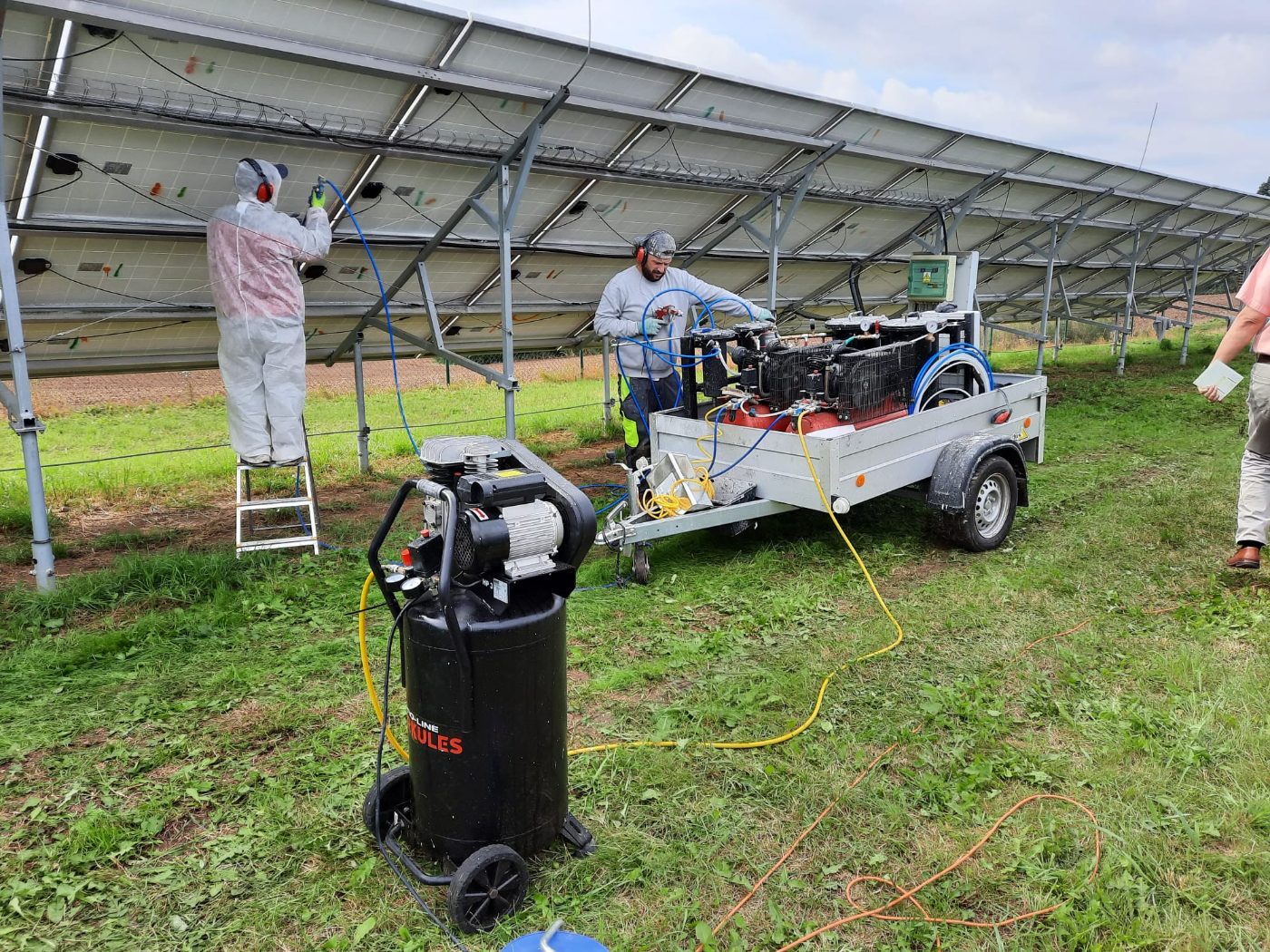
Mobile rigs re-encapsulate the failing modules in silicone gel where they stand — no removal, no factory return.
Step 4 · Verify
Re-measure and return to service
Renovated modules are re-measured wet and returned to operation within the insulation limit.
Field measurements
We measured 37 modules wet. One in five failed.
In a study of 37 utility-scale crystalline-silicon modules, wet-state insulation resistance ran roughly 110 times lower than the same panels measured dry. Under the IEC 61215 wet limit, 21.6% failed — including five that had passed the dry screening test.
That gap between dry-tested and wet-operating panels is the entire basis for renovation: inspection tells a PV plant operator precisely which modules to renovate, and which to leave alone.
Direct reply by Vladislav Poulek
Request a renovation assessment.
Tell us the plant location, module count, age, and what you are observing — Vladislav Poulek will reply personally about a wet-state assessment.